
Dismantling our Navy could turn NZ into a formidable defence force
Dr Del Carlini is a strategic theorist and writer in geopolitics, military strategy and security from Wellington.
This article first appeared in The Post 10 August 2026
OPINION: There is an adage that the only thing harder than getting a new idea into military thinking is to get an old idea out. Here’s a new idea: New Zealand doesn’t need a Navy; we need marine defence instead.
Trying to modify our navy will run into huge resistance from people who have built careers in pre-Ukraine War naval tactics. However, if we dismantle it, we are freed to think about marine defence in quite different ways; we have a blank canvas to design exactly what we need with the technologies and warfare experience now available.
Our Navy hasn’t been a functional force for decades. Of our eight remaining naval vessels, four cannot put to sea. Our Navy can’t attract the skilled people it needs. Drone and missile warfare in Ukraine and Iran has shown surface vessels are particularly vulnerable and even obsolete, at a time when our whole fleet is due for replacement.
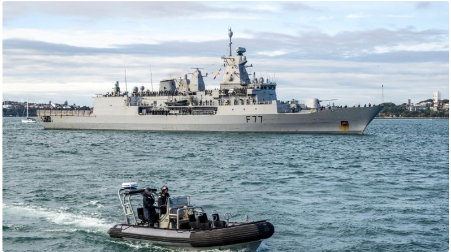
The Royal New Zealand Navy frigate HMNZS Te Kaha returning home to Devonport in 2025.Photo: NZ Defence Force
The need to replace is not a problem, but an opportunity. Everything a surface naval ship is used for can now be achieved in cheaper and more effective ways.
The reality is, we have very few missiles to arm our vessels, which defeats the purpose of having frigates. Our Navy has poor warfighting capability. And now the new Marine Fleet Renewal Programme identifies that training creates wear and tear on vessels, so future naval training will take place in simulators onshore instead of sea time. That would be pure comedy if the consequences were not so serious.
I argue there are two scenarios of defence we need to prepare for. One is for defence of our own sovereign territory built on an ability to act alone. That includes deeply constructed deterrence so any hostile nation knows it will be too difficult and too expensive to risk attacking New Zealand.
The second scenario is expeditionary, where New Zealand plays a part in a larger military effort anywhere in the world in alliance with friendly nations.
Doing away with the concept of a navy means we are free to reimagine. Given the experience in Ukraine and Iran, the opportunity is to have no large naval vessels and instead have thousands of New Zealand-made marine surface and sub-surface drones patrolling and ready for action alongside aerial drones and satellites. Instead of having one frigate with a couple of obsolete missiles, we can have every drone armed and observing over a large area.
Ukraine continues to innovate its marine drone fleet, but that is largely within the calmer waters of the Black Sea. There will be demand for drones with proven capabilities in heavy seas and icy conditions as well as the humid and reef-strewn Pacific Islands. Instead of a frigate or any surface ship, put a billion dollars, incentives and government support into local companies in a nation that prides itself on innovation and watch what happens. Joint venture with Ukraine, and we have turned a cost into an industry, and have marine defence in place rapidly instead of waiting a decade or more for just one ship.
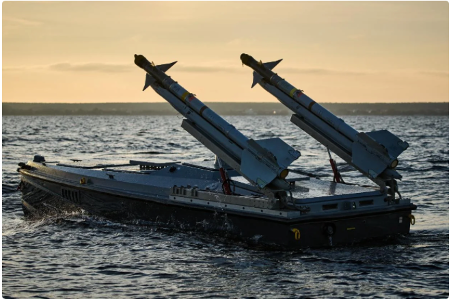
A Ukrainian sea drone equipped with surface-to-air missiles, part of the arsenal which have helped it destroy a large part of the Russian Navy’s Black Sea fleet.Photo: Efrem Lukatsky / AP
Another component would be to have shore-based mobile missile capability able to move around the country, produced in New Zealand with Ukrainian cooperation.
We will need the ability to locally produce sea mines and have the capability to lay them and then retrieve them, one of the tasks Ukraine is using drones for.
Under a marine defence scenario our contribution to expeditionary forces is not another frigate, but our marine and submarine drone expertise. Imagine the Rimpac exercise; instead of sending a single frigate to join 50 others, New Zealand could send drone swarms capable of putting 10 marine drones around each of the frigates from allied defence forces, moving us from an unimportant add-on to being of serious value.
A further element is to distribute basing. The plan as now written is to spend enormous sums upgrading our one naval base, Devonport. Any enemy could quickly cripple that base. Instead, we could have endless configurations of marine and aerial drones and missile systems based on our home islands and on outer islands such as the Kermadecs, Chathams and sub-Antarctic islands.
To get to the core of what marine defence might be, first we carve away functions that are not marine defence – fisheries protection, customs and disaster response.
Our foreign policy during peace time is based on two things: security and prosperity, which provides a rationale for fishery protection being a prosperity issue. But, in war, our foreign policy will move to security and survival of our freedoms and way of life.
We also need to jettison disaster response as a military issue. When a naval vessel turns up in Tonga following a cyclone or in Kaikōura after an earthquake, it can provide assistance, but it is not built for that purpose. Wouldn’t it be preferable to create a multi-nation funded disaster response effort that takes that function away from all defence forces?
Under a reimagined marine defence, we will be operating at the leading edge of warfare development rather than always having obsolete vessels in need of constant expensive upgrades. Instead of having all our funds tied up in large single assets, we have the ability, through constant innovation, to pivot design and manufacturing to whatever is needed at that time.
It won’t be hard to attract people to a force that is innovative rather than moribund. And most important, where our Navy of today would strike no fear in the heart of an enemy, the reimagined future will ensure possible aggressive actions against our country will be thought of as too risky and costly. Ukraine has shown this is not theoretical, it is where warfare has already moved to.
China wants a piece of Antarctica to extract resources. Its recent mode of operation, used in the Philippines Malaysia, and Vietnam, has been to start hybrid warfare by sending in thousands of militia vessels operating as fishing boats with Chinese naval protection to steal resources and overwhelm local defence. We can expect the same techniques in our waters.
If a hostile China sends a naval force through a contested Tasman Sea and into southern waters, we could do nothing with one, two, three or even 10 frigates. But with missile systems and swarms of thousands of armed aerial, surface and sub-surface drones, New Zealand would be formidable.